
If your home starts to feel itchy, static-prone, and stuffy the moment the cold sets in, you are experiencing a very normal New England winter problem: dry air and trapped pollutants. Sealed-up houses keep heat in, but they also hold onto dust, dander, cooking particles, VOC’s (volatile organic compounds) and viruses more than at any other time of year. The result is dry skin, sore throats, static shocks, creaky hardwood floors, and a general sense that the air is “heavy” even when the thermostat looks fine.
This guide breaks down why winter air quality slides, how to target a healthy 30 to 50 percent indoor humidity, and which whole-home solutions actually work. It is written for homeowners in southeastern Massachusetts, Bristol County, RI, and Newport County, RI, including Providence, Barrington, Seekonk, East Providence, Bristol, Warren, Newport, Middletown, Portsmouth, Tiverton, Swansea, and Westport. You will find clear steps you can do today, along with professional options from Lawrence Air Systems using AprilAire humidification and purification.
Why winter wrecks indoor air quality
Cold outdoor air cannot hold much moisture. When that air is heated indoors, the relative humidity drops sharply. At the same time, windows and doors stay shut, so whatever is generated inside tends to linger. Common winter contributors include long-simmering meals, candles, cleaning sprays, wood-burning appliances, pet dander, and fine particles released every time fabrics are handled or vacuuming stirs up settled dust.
Dry air itself is not a pollutant, but it is a multiplier. When relative humidity falls much below 30 percent, nasal passages dry out and become more easily irritated, static discharges increase, hardwood shrinks and gaps, and airborne particles remain suspended longer because they are less likely to clump and fall. That is why an otherwise clean home can feel dusty and uncomfortable in January.
How dry is too dry
The fastest way to know is by measuring your indoor relative humidity. Healthy indoor winter humidity lives between 30 and 50 percent. Below 30 percent, you will notice chapped lips, a scratchy throat, and static shocks when you touch metal. Above 50 percent, you risk condensation on windows, musty odors, and microbial growth in cold corners. The sweet spot for most New England homes is 35 to 45 percent, adjusted slightly based on outdoor temperature to prevent window condensation during very cold nights.
If you do not already have a way to measure humidity, our technicians use a psychrometer during service visits to accurately determine your home’s relative humidity. Having a real number in front of you changes the conversation from guesswork to control, and makes it much easier to dial in comfort without risking moisture problems.
First, control sources and habits
Before buying equipment, do a quick tune-up on daily routines.
- Cook with the range hood on and vented outdoors. Ten focused minutes on a higher setting is better than an hour on low.
- Run bath fans for 15 to 20 minutes after showers. If the fan is noisy or ineffective, it may need cleaning or replacement.
- Store bulk cleaners and paints in the garage or a sealed area rather than mechanical rooms.
- Vacuum with a high-quality bagged machine and a sealed body. Bagless designs that leak undo your effort.
- Avoid scented candles and heavy sprays if someone in your home is sensitive. They add particles and volatile compounds that are harder to filter.
These small actions reduce what needs to be removed later.
The case for whole-home humidification
Portable humidifiers help a single room for a few hours, then run out of water or mineral scale reduces output. They also require constant cleaning. Whole-home humidifiers solve that by linking directly to your ducted system and distributing moisture evenly. There are whole-home humidification solutions for homes without ductwork as well.
AprilAire solutions include three main approaches. The right fit depends on your equipment and home layout.
- Bypass humidifiers use the furnace’s blower heat to evaporate water across a media panel. They are simple, reliable, and effective for many gas furnace homes.
- Fan-powered humidifiers add their own small fan to improve evaporation when blower heat is limited. This helps in homes with shorter call times or lower supply temperatures.
- Steam humidifiers generate clean steam and inject it into the duct stream. They deliver high output regardless of supply air temperature and are ideal for larger homes, tight envelopes, or spaces that need precise control.
We pair the humidifier with an automatic control that adjusts the target humidity to the outdoor temperature. That avoids window condensation on frigid nights while preserving comfort. Typical targets are 40 to 45 percent when it is around freezing outside, tapering toward 30 to 35 percent when it drops into the teens.
Whole-home purification that actually moves the needle
Filtration is about two things: catching particles and maintaining airflow. Go too low on filtration, and pollutants slip through. Go too high on resistance and your blower works too hard, raising energy use and noise. The sweet spot is a deep media filter with high capture and low pressure drop.
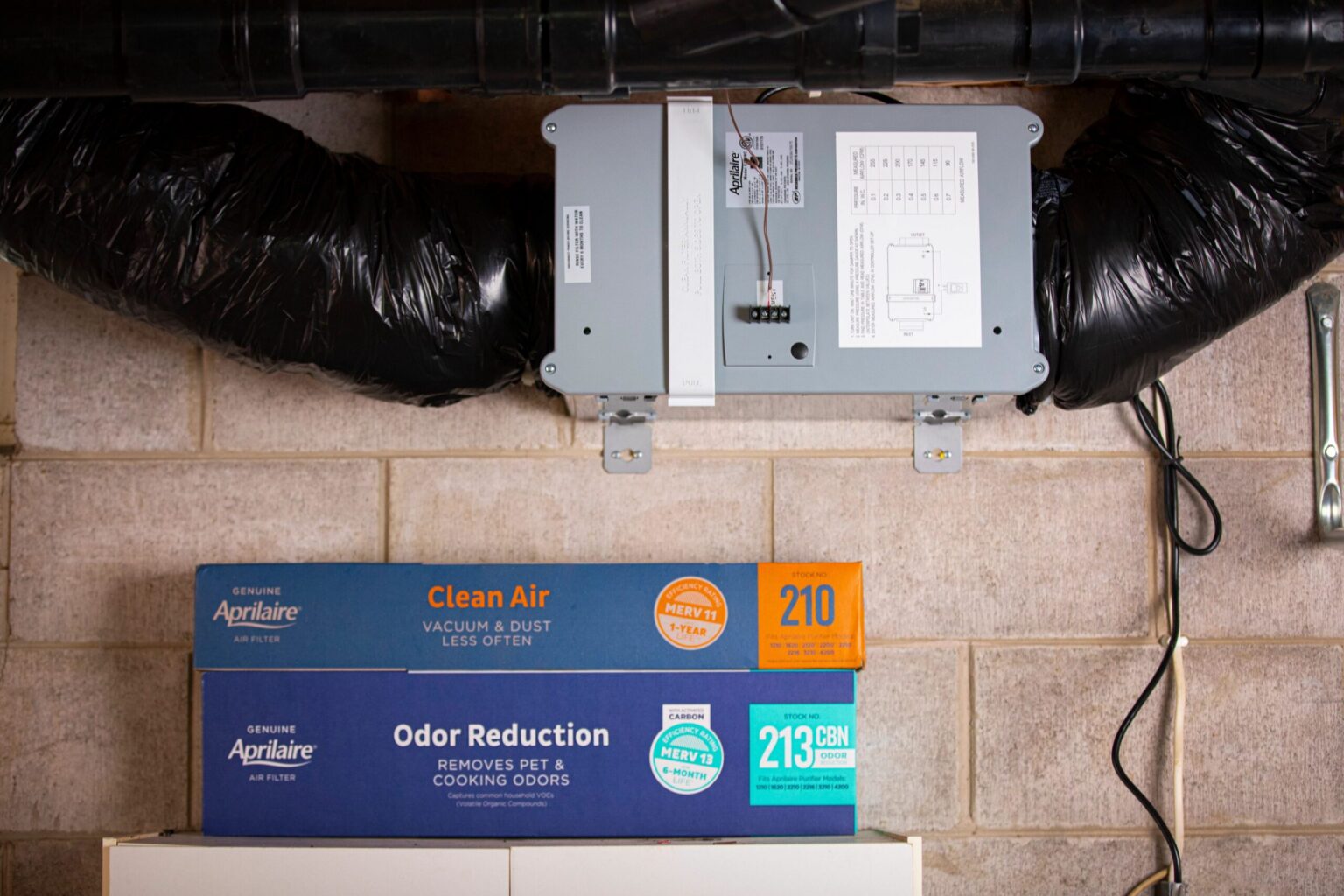
AprilAire whole-home cleaners use deep-pleat media to increase surface area. That gives you MERV 13-plus filtration without choking the system. Unlike thin one-inch filters, these media cabinets are designed for a tight fit that does not leak around the edges. They are changed every 6 to 12 months in most homes, not every 30 days.
What they remove: common dust and dander, many fine particles from cooking and candles, and a significant share of airborne allergens. Pairing deep media filtration with good humidity control also helps particles settle and catch more efficiently.
If you have family members with asthma or strong sensitivities, we can review additional technologies, but deep media filtration plus correct humidity solves most winter comfort complaints without adding complexity.
Balancing humidity and fresh air without wasting heat
Fresh air is important, especially in tight homes. In winter, the trick is to manage it without throwing away heat or boosting humidity into the window-sweat zone. There are two main tools.
- Timed or demand-controlled ventilation. Short, well-placed bursts of fresh air give you the benefits without the penalty of leaving fans on all day.
- Energy recovery ventilation. In very tight homes, an ERV can exchange heat and some moisture between outgoing and incoming airstreams. That tempers both the energy impact and the dryness.
If you are not sure whether your home needs mechanical ventilation, ask us during a visit. Many older homes in Providence and New Bedford already leak enough; the bigger gains come from humidity and filtration. Newer or recently weatherized homes benefit from controlled, measured fresh air instead of random leaks.
Measuring success
You cannot manage what you do not measure, and winter air responds quickly to small changes.
- Place one hygrometer on the main floor away from direct supply air and another in the primary bedroom. You are aiming for 35 to 45 percent most days.
- Check your filter monthly and replace media on schedule. If you are unsure about the right specification, we will size it to your blower so airflow remains healthy.
- Watch your windows. A line of moisture on the bottom edge in a cold snap is normal. Persistent wet glass, pooling on sills, or microbial growth on frames means humidity is set too high or you have cold bridges that need attention.
- Pay attention to sound. A quiet, steady system after a Total System Cleaning usually means airflow and filtration are in balance. Roaring or whistling registers point to restrictions.
Why work with Lawrence Air Systems
We are a family-run team with more than five decades of service in southeastern Massachusetts, Bristol County, RI, and Newport County, RI. Our approach is simple and neighborly. We start with the fundamentals, speak plainly, and recommend solutions that match your home and goals. We install and support AprilAire whole-home humidifiers and purifiers, and we build every project around solid airflow, proper sizing, and clean ducted paths so the equipment you buy delivers what it promises.
Members receive priority scheduling and access to after-hours service, reduced service repairs, and replacement costs. If you need help quickly because the air feels harsh, bedrooms are dry, or windows keep fogging, we can inspect, measure, and propose a clear plan.
Ready to breathe easier this winter
If you want your home to feel warm without the dryness, quiet without the heaviness, and clean without constant fussing, whole-home humidity and filtration are the most reliable path. Pair that with a Total System Cleaning and small habit changes, and you can hold a steady 35 to 45 percent humidity, reduce airborne irritants, and protect the wood and finishes you care about.
Call(401) 227-5410 to schedule an in-home air quality assessment, learn about AprilAire solutions, or ask how a maintenance membership can keep your system tuned through the coldest months. Clear solutions, straight answers, and winter air that finally feels right.